Cooktop Repair: Why Burners Stop Heating
Cooktop repair help for burners that will not heat, spark, or stay on. Learn the likely causes, safe five-minute checks, and when to call for service.
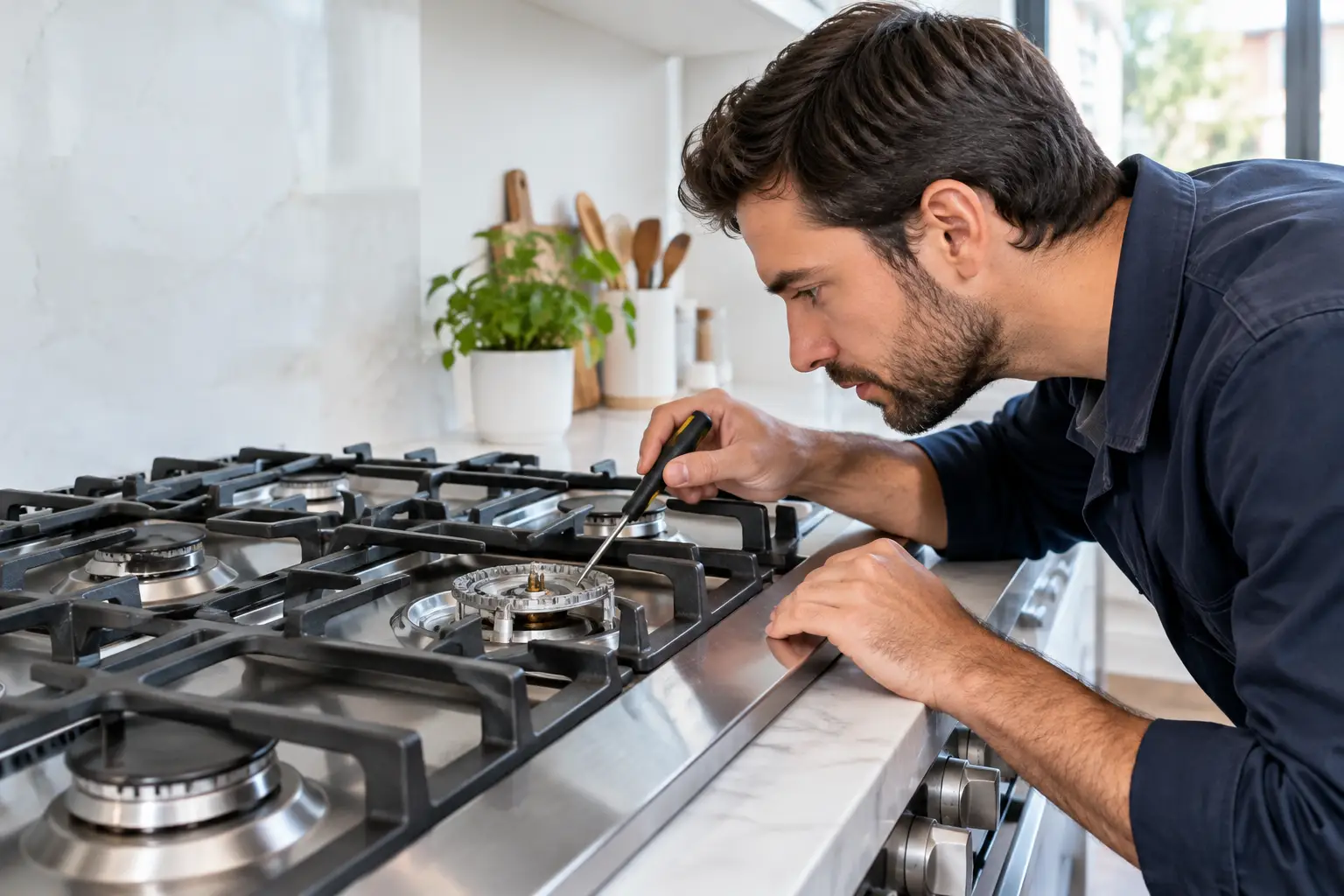
A cooktop burner that will not heat is usually caused by a failed surface element or burner, a bad control switch, or a loose wire connection. If it sparks but will not light, the usual cause is blocked burner ports, a wet igniter, or a failed spark electrode.
Cooktop repair starts with the exact symptom. A burner that is completely dead needs a different test than one that heats only on high, clicks nonstop, or shuts off after a few minutes. This matters because the part you can see is not always the part that failed.
Why will one cooktop burner not heat?
On an electric cooktop, one dead burner often points to the heating element or its control switch. Coil elements can burn out internally. On glass-top models, the radiant element under the glass can fail. The element may look normal but still have an open circuit inside it.
The other common cause is the infinite switch. This is the control behind the knob that cycles power to the burner. When it fails, the burner may not heat at all, may heat only at full power, or may keep heating after you turn the knob down.
Induction cooktops are different. They need the correct magnetic cookware, and the pan must sit flat in the marked cooking zone. If a compatible pan is in place and the zone still shows an error or does not detect the pan, the issue may be the induction module, temperature sensor, or cooling fan. Those parts are inside the unit and should be checked by a technician.
For a gas cooktop, a burner that will not light may have food residue or moisture blocking the small burner openings. It can also have a cracked spark electrode, a weak spark module, or a bad valve switch. If there is no spark on any burner, the spark module or its power supply is more likely than four separate failed igniters.
What can I check in five minutes before calling?
First, turn every cooktop knob to OFF. Let the surface cool if it was recently used. Then remove the burner cap and burner head on the burner that will not light. Wipe away grease, water, and loose food with a dry cloth. Check that the cap sits flat and the small openings around the burner head are not covered.
Put the pieces back in the same position and try the burner again. A burner cap that is slightly off-center can prevent the flame from spreading correctly. If the burner clicks but does not light, do not keep clicking it for several minutes. Turn it off and wait for any gas smell to clear.
For an electric cooktop, you can check the breaker panel once. A partly tripped breaker can leave some functions working while others do not. Move the cooktop breaker fully to OFF, then back to ON. If the breaker trips again, stop there. Repeated tripping can mean a shorted element, damaged wire, or failed control.
Do not remove the glass surface, open the electrical panel, or test live wires. Cooktops use high voltage, and gas models also involve fuel connections.
Is the burner itself really the problem?
What people usually assume is that a burner that does not heat must have a bad burner. That is a reasonable guess because the problem appears in one spot and the other burners may work normally.
It is often incorrect. The burner is only one part of the circuit. A burned terminal block, loose connector, failed infinite switch, or damaged wiring can stop power before it reaches the element. On glass cooktops, heat damage at the wire terminals is common because those connections work under high temperature for years.
What it actually is can be found with testing. A technician checks whether the element has continuity, then checks whether the control is sending the correct voltage to it. If the element tests good but does not receive power, replacing the element would not fix the cooktop. This is why a diagnosis is worth doing before ordering a visible part.
Why does my gas cooktop keep clicking?
Constant clicking usually means the ignition system senses moisture or a path to ground where it should not. It often happens after boiling water spills over, after cleaning the cooktop, or when a burner cap is not seated correctly.
Start by turning the knobs off and drying the burner area. Leave the surface uncovered for several hours if there was a large spill. If clicking continues after the cooktop is dry, the spark switch under a knob, spark electrode, or spark module may be failing.
A clicking burner that lights normally may still need attention if the clicking does not stop. The repeated spark can wear down the ignition parts. If you smell gas and the burner does not light, turn the knob off, ventilate the area, and do not use matches or lighters to force ignition.
Why does my electric cooktop get too hot or stay hot?
A burner that only runs on high heat often has a failed infinite switch. The switch is supposed to cycle the element on and off to hold a lower heat setting. When its contacts stick closed, the element gets full power even when the knob is set low.
If a burner continues heating after the knob is turned off, turn off the cooktop breaker. Do not leave the unit powered while waiting for service. This is not a problem to watch for a few days because the surface can become hot again without warning.
The hot-surface light is a separate issue on many models. That light can stay on after the top is cool if its limiter switch or sensor fails. The cooktop may still heat normally, but the warning light should be repaired so people in the home know when the surface is actually hot.
When is cooktop repair the better choice?
Repair usually makes sense when one part has failed and the cooktop is otherwise in good condition. A single radiant element, gas igniter, control switch, or terminal repair is often more practical than replacing a built-in unit. This is especially true in condos and rental properties, where a replacement may require matching the existing countertop opening.
It depends on the condition of the appliance. A cracked glass surface, repeated electronic failures, heavy corrosion, or several dead burners can change the decision. Parts for some older or discontinued models may also be unavailable. A technician can identify the failed part and tell you whether repair is realistic before work begins.
For homeowners, tenants, and property managers in West Hollywood, quick reporting helps prevent a smaller fault from becoming a safety issue. Tell the technician which burner fails, whether it is gas, electric, or induction, and whether the problem happens all the time or only at certain settings. A model number from the cooktop frame or underside is helpful too.
Vertex Appliance Repair performs in-home cooktop and range service in West Hollywood and nearby neighborhoods. The diagnostic fee is $89 and is waived when the repair is approved. Installed parts and labor are covered for 90 days.
If a burner will not heat, will not stop heating, or clicks without lighting, turn it off and avoid using that section of the cooktop. A clear symptom and a safe first check can make the repair visit faster and keep the rest of your kitchen usable.