Freezer Repair When Food Is Soft but Unit Runs
Need freezer repair in West Hollywood? Learn what soft food, frost, and warm shelves mean, what to check, and when a technician should test your system.
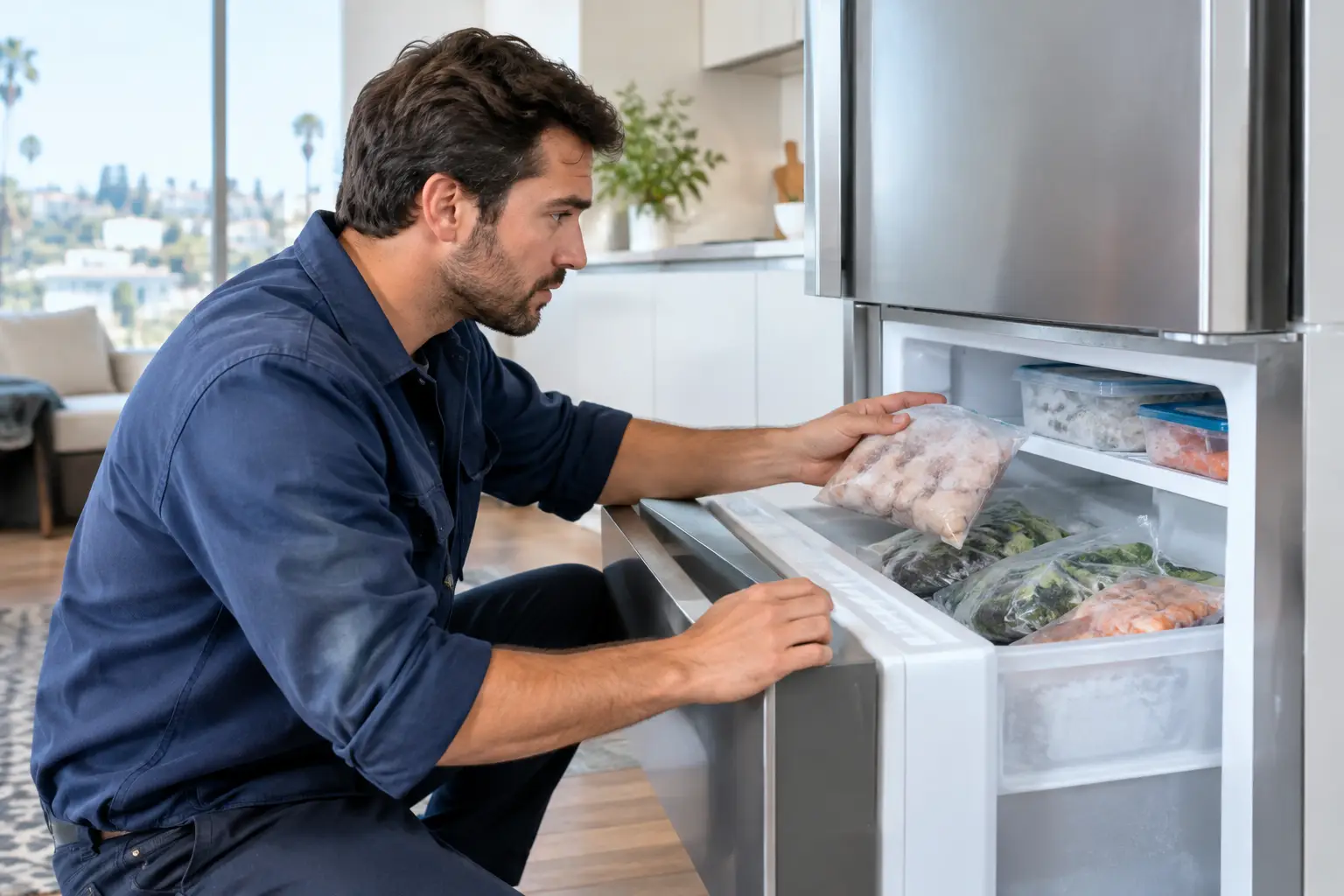
A freezer that runs but cannot keep food frozen usually has an airflow, defrost, or compressor-start problem. Freezer repair starts with finding out whether the cold air is not being made, not moving, or escaping through a door seal.
Soft ice cream, thawing meat, or a rising temperature needs attention before food becomes unsafe. A working freezer should generally hold 0°F or below. If it is above 10°F for hours, move food to another freezer or use a cooler with ice while the problem is checked.
Why is my freezer running but not cold enough?
Start with the sound and the temperature. A freezer that runs almost all the time but stays warm may have dirty condenser coils, a failed evaporator fan, a defrost failure, or a sealed-system issue. The sealed system is the compressor, refrigerant, and tubing that remove heat from the cabinet.
If the inside light works and you hear a fan, that does not prove the freezer is cooling correctly. One fan may be running while another is not. Many refrigerator-freezer units have a condenser fan near the compressor and an evaporator fan behind the rear freezer panel. The evaporator fan pushes cold air through the freezer and, on many models, into the refrigerator section too.
A freezer with no fan sound when the door switch is pressed may have a bad evaporator fan motor, door switch, wiring problem, or control board issue. The door switch matters because most models stop the fan when the door is open. A technician checks voltage at the fan motor before replacing it.
If you hear a click near the back every few minutes, followed by a short hum, the compressor may be trying and failing to start. The start relay and overload are common causes. The compressor itself can also be the problem, and that changes the repair decision.
What can I check myself in five minutes?
Close the freezer door on a dollar bill or a sheet of paper. Pull it out slowly. Repeat this at the top, bottom, and both sides of the door. If the paper slides out with almost no resistance in one area, the gasket may not be sealing there.
Clean any food, crumbs, or sticky residue from the gasket and the edge of the cabinet with warm water and mild dish soap. Check for a twisted gasket or a container that stops the door from closing. Do not use a hair dryer or sharp tool on the gasket. Heat can warp it, and a puncture can make the seal worse.
Also check that vents inside the freezer are not blocked by frozen food packages. Air needs a clear path. Packing food tightly against the rear wall can reduce airflow and make one shelf much warmer than another.
Is heavy frost the reason my freezer stopped cooling?
What people usually assume
Most people see a thick layer of frost on the rear freezer wall and assume the door was left open. That is a reasonable guess. A door left ajar does bring humid room air into the freezer, and that moisture turns to frost.
Why that assumption is often incorrect
When the frost keeps returning after the door is fully closed, the problem is often not the door. The freezer may not be going through its automatic defrost cycle. Frost then covers the evaporator coil behind the rear panel. Cold air cannot pass through the ice-covered coil, so the freezer gradually warms up even though the compressor still runs.
What it actually can be
The failed part may be a defrost heater, defrost thermostat, thermistor, control board, or defrost timer on older models. The heater melts normal frost from the evaporator coil. The thermostat or sensor tells the system when the coil is cold enough for defrost. The control board or timer starts the cycle.
A full manual defrost can make the freezer cool again for a few days. That does not fix the cause. It only removes the ice. If the same frost pattern comes back, the defrost circuit needs testing. Replacing a control board first, without checking the heater and sensor, can waste money.
Why is only part of my freezer cold?
A partial frost pattern on the evaporator coil can point to a refrigerant restriction, low refrigerant from a leak, or a weak compressor. This is different from a coil packed evenly with white frost. A technician needs to remove the rear panel and inspect the frost pattern after the unit has run.
This problem is not always worth repairing. It depends on the model, age, condition, and whether the leak can be located and repaired. Adding refrigerant without fixing a leak is not a real repair. The cooling will drop again.
Condenser coils can also raise temperatures, especially on units with coils underneath or behind the cabinet. Dust and pet hair trap heat around the condenser. The compressor then works harder and runs longer. Cleaning accessible coils can help, but it will not solve a failed fan, weak compressor, or defrost issue.
Why is my freezer cold but food is still getting soft?
Temperature can vary more than people expect when air is blocked or a sensor is reading incorrectly. Food near the back wall may freeze while food near the door softens. A bad thermistor can send the control board the wrong temperature. The board may stop cooling too early or run the compressor longer than it should.
Use a freezer thermometer rather than relying only on the display. Put it between food packages near the center of the compartment. Check it after several hours with the door closed. A display can be inaccurate if its sensor is in a colder or warmer spot than the food.
Ice buildup around air vents is another clue. In a refrigerator-freezer combination, a damper controls cold air moving between compartments. A stuck damper can leave the refrigerator too warm, too cold, or cause uneven freezer temperatures. The exact layout depends on the model.
When should I stop using the freezer and call for repair?
Call for freezer repair if the temperature stays above 10°F, the unit clicks repeatedly, the compressor is very hot, or the freezer has a strong burning smell. Unplug the unit if you smell burning plastic, see damaged wiring, or hear a loud electrical buzzing that does not stop.
Do not chip ice with a knife or screwdriver. It is easy to puncture the evaporator coil behind the freezer panel. That can turn a defrost repair into a sealed-system repair. Avoid removing panels unless you are comfortable working around electrical parts and know how to put the air ducts and insulation back correctly.
For renters, report the temperature and symptoms to the landlord or property manager as soon as possible. A photo of the thermometer and the frost pattern can help. For property managers, quick diagnosis matters because a freezer failure can lead to food-loss complaints and repeat visits if the wrong part is ordered.
What happens during a freezer repair visit?
A proper diagnosis includes checking cabinet temperature, airflow, door seals, fan operation, frost pattern, and compressor behavior. Depending on the symptom, the technician may test the start relay, evaporator fan motor, defrost heater, thermistor, and control board. These checks separate a simple electrical part failure from a compressor or refrigerant issue.
Vertex Appliance Repair serves West Hollywood and nearby neighborhoods for in-home freezer problems. The diagnostic fee is $89 and is waived when the repair is approved. Installed parts and labor are covered by a 90-day warranty.
Keep the doors closed as much as possible while you arrange service. Every door opening adds warm, moist air, and that can make an already weak freezer take longer to recover.