Water in the Bottom of Your Dishwasher? Causes and Fixes
Dishwasher standing water usually points to a drain problem. Learn safe five-minute checks, hidden causes, and when to call a local repair technician.
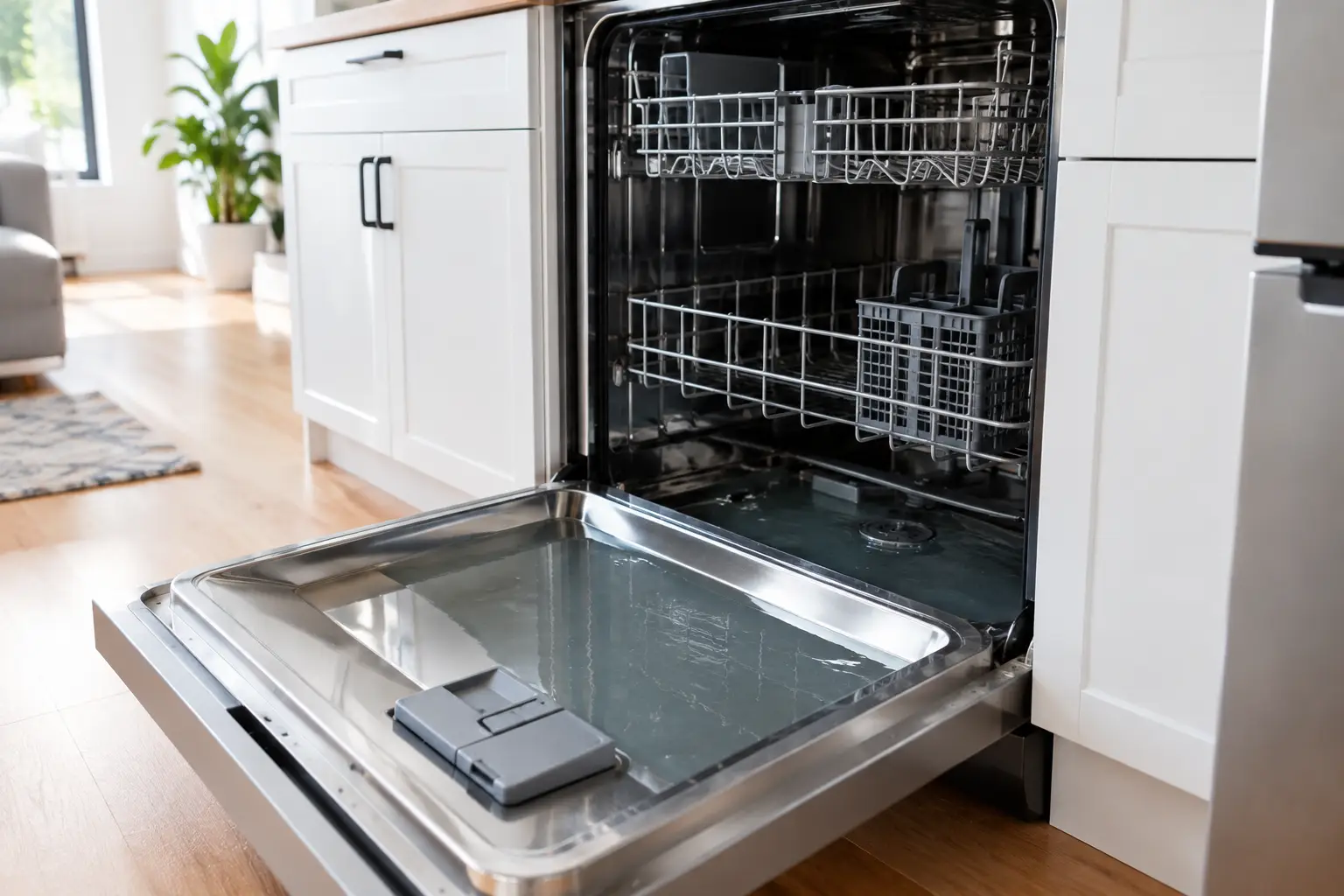
Dishwasher standing water is usually caused by a blocked drain path, a clogged filter, or a drain pump that cannot move water out. If water remains at the bottom after a cycle, do not keep running the dishwasher until you find the cause.
Quick answer: water sitting in the bottom of a dishwasher almost always means the water can’t get out. On a service call I check four places in this order: the air gap next to the kitchen faucet, the filter, the drain hose and garbage disposal connection, and the drain pump. Most of the time it is the first two, and you can check them yourself.
A small amount of clean water below the filter screen can be normal on some models. A visible pool of dirty water in the tub is not. It can leave food debris, create odors, and leak onto the floor if the problem gets worse.
Why is there water in the bottom of my dishwasher?
Your dishwasher drains through several parts, not one simple hose. Water passes through the filter area, sump, drain pump, drain hose, and then into the sink drain or garbage disposal connection. A restriction anywhere along that route can leave water behind.
The most common issue is food debris in the filter or sump. Glass chips, labels, bones, twist ties, and small pieces of plastic can also stop the drain pump impeller. The impeller is the small spinning part inside the pump that pushes water through the hose.
A kinked drain hose is another common cause. This can happen after work under the sink, a cabinet repair, or a dishwasher that was pulled forward and pushed back. The hose may look fine from the front while it is pinched behind the machine.
In condos and older buildings around West Hollywood, the dishwasher may also be draining into a slow kitchen sink line. If the sink backs up or drains slowly, the dishwasher has nowhere to send its water. That is a plumbing issue, not always a dishwasher failure.
What can I check in five minutes?
Turn off the dishwasher and remove the lower rack. Take out the filter, which usually twists or lifts out from the bottom center of the tub. Rinse it under warm running water and remove grease, food, and paper labels from the mesh.
Then use a flashlight to look into the opening below the filter. Remove any loose debris you can clearly reach. Do not put your hand deep into the sump, and do not force tools into the drain pump area. A sharp piece of glass can be hidden under dirty water.
After reinstalling the filter, run the dishwasher’s Cancel or Drain cycle. Listen for a steady low hum and water moving through the drain. If you hear a hum but no water leaves, there may be a blockage or a jammed pump. If the dishwasher is completely silent during the drain portion, the drain pump, wiring, control board, or door latch circuit may need testing.
Is a clogged filter always the problem?
What people usually assume: the filter is clogged because the dishwasher has standing water.
Why that assumption is reasonable: filters do collect food and grease, especially when dishes are loaded without being scraped. Cleaning the filter is the right first step, and it often solves the problem.
Why it is often incorrect: a clean filter does not prove the drain system is clear. Water may be trapped farther down in the drain hose, at the air gap, at the garbage disposal connection, or inside a weak drain pump. A dishwasher can also have a clean filter and a broken pump impeller.
What it actually is in many service calls: the drain hose has a blockage, or the drain pump is running but no longer pushing enough water. We also find disposal inlet plugs that were never removed when a new garbage disposal was installed. That plug blocks the dishwasher drain completely. This is common when the dishwasher worked before a sink or disposal replacement and then suddenly stopped draining.
Why does my dishwasher drain sometimes but not every time?
An intermittent drain problem often points to a partial blockage or a failing pump. A partial clog may let water through during a short cycle but stop up when food particles shift into the hose. You may notice that the dishwasher drains after one cycle but leaves water after another.
A weak drain pump can do the same thing. The motor may hum and the pump may move a little water, but it cannot overcome normal resistance in the hose. Some pumps become noisy before they fail. Others sound normal but have worn internal parts.
The dishwasher control board also decides when to power the drain pump. If the board does not send power at the right time, the appliance may wash normally and then stop with water in the tub. A technician can check voltage at the pump during the drain cycle. That test separates a pump problem from a control or wiring problem.
Could the garbage disposal cause dishwasher standing water?
Yes. Start by checking whether the kitchen sink drains quickly. Fill the sink partway with water, then release it. Water should move down freely without rising back into the dishwasher.
If you have a garbage disposal, run cold water and operate the disposal briefly. Food buildup inside the disposal connection can block the dishwasher outlet. Never reach into a disposal, even when it is switched off.
Some homes have an air gap next to the faucet. It is the small cap-shaped fitting on the sink deck. If water comes out of that fitting while the dishwasher tries to drain, the hose after the air gap may be clogged. If there is no air gap, the drain hose should still loop high under the sink cabinet. That high loop helps prevent sink water from flowing backward into the dishwasher.
What if the drain pump is jammed?
If the air gap, filter and hose are clear, the drain pump is next. A small bone, an olive pit or a piece of broken glass can get past the filter and lock the pump impeller. The pump hums or stays silent, and the water stays in the tub. Clearing the object can bring the pump back, but a pump that ran for a while while jammed may have overheated, so I usually recommend replacing it.
One detail matters here: install the pump made for that exact model. Some inexpensive look-alike pumps have flat impeller blades instead of angled ones. They fit, but they move water differently and the dishwasher can keep showing a drain error, which makes it look like a control board problem when it is not.
Why is there water in the bottom of my dishwasher when it’s not in use?
First look at the water. If it is dirty, with food bits, it is a drain problem: the dishwasher did not finish draining, or sink water is flowing back through a clogged air gap or a drain hose with no high loop.
If you open the door to load dishes and find clean water sitting in the tub, that is a different problem: the water inlet valve is not closing all the way. Water slowly seeps in while the dishwasher is off and keeps filling the tub. Left alone, it can overflow onto the floor and into the cabinet.
What to do: shut off the water supply to the dishwasher (the valve is usually under the kitchen sink) and call a technician. The fix is replacing the inlet valve.
When should I stop trying to fix it myself?
Stop if the water is dirty, there is a bad odor, the dishwasher leaks, or the drain cycle makes a grinding sound. Also stop if you find broken glass, a damaged hose, or water under the cabinet. Repeatedly restarting a dishwasher with a blocked pump can overheat the pump motor.
For renters, report standing water early. It is easier for a landlord or property manager to handle a drain problem before it damages the cabinet base or flooring. Take a photo of the water level and note whether the sink is draining normally. Those details help narrow down the cause.
For homeowners in West Hollywood, a dishwasher repair visit can test the drain pump, check the hose route, inspect the check valve, and confirm whether the problem is inside the appliance or in the sink drain. Vertex Appliance Repair charges an $89 diagnostic fee, which is waived when you approve the repair. Labor and installed parts are covered for 90 days.
What if the dishwasher fills back up after it drains?
If the dishwasher drains and then water slowly returns, the problem may not be the drain pump. Sink water can flow backward through a low or poorly routed drain hose. A blocked air gap or a missing high loop can cause this. A disposal connection problem can also allow dirty sink water to enter the dishwasher.
This symptom matters because replacing the drain pump would not fix it. The hose routing and sink drain connection need to be checked first.
If your dishwasher has standing water after you clean the filter and run a drain cycle, leave the door closed and avoid using it until the cause is found. A quick repair now can prevent a bigger leak under the kitchen cabinet later.