




Why Is Oven Not Heating? 7 Common Causes to Check
Why is oven not heating? Learn the common causes, safe checks to try, and when West Hollywood homeowners should schedule a local oven repair visit today.
You set the oven to 350, wait for it to preheat, and the kitchen never gets warm. When people ask, “why is oven not heating,” the answer is usually a failed heating part, a power problem, or a control issue. The symptom matters. An oven that stays cold needs a different check than one that heats slowly or only heats on broil.
Before trying anything, turn the oven off and let it cool. Do not take apart wiring or remove gas parts. A built-in oven and a range both use high voltage. Gas models also involve a gas supply and ignition system.
Why Is Oven Not Heating? Start With the Symptom
A few simple details can point toward the problem. Look at the display, listen for normal operation, and notice whether either heating mode works.
If the oven light and display are completely dead, the issue may be the outlet, breaker, power cord, or house wiring. If the display works but the oven stays cold, the fault is more often inside the appliance.
Try both Bake and Broil one time. Do not leave the oven running unattended during this test. If Broil works but Bake does not, the lower bake element or bake igniter is often the cause. If Bake works but Broil does not, the upper broil element or its circuit may have failed. If neither mode heats, the problem may be power, the electronic control board, a sensor, or a safety part.
Check the Power Supply First
Electric ovens need 240 volts to heat. The clock, light, and display can still work when the oven has only partial power. This is common after a breaker trips on one side.
Go to the electrical panel and check for a breaker that is in the middle position. Turn the oven breaker fully off, then back on. Do this only once. If it trips again, stop using the appliance and arrange service. A breaker that repeatedly trips can point to a shorted heating element, damaged wiring, or another electrical fault.
For a plug-in range, make sure the heavy power cord is firmly connected. Do not pull the range out by yourself if it is difficult to move or the cord looks damaged. The outlet and cord can carry dangerous voltage even when the oven is off.
A gas oven still needs electrical power for the control, spark system, and glow igniter. So a dead display can stop a gas oven from heating too.
A Bad Bake Element Is Common on Electric Ovens
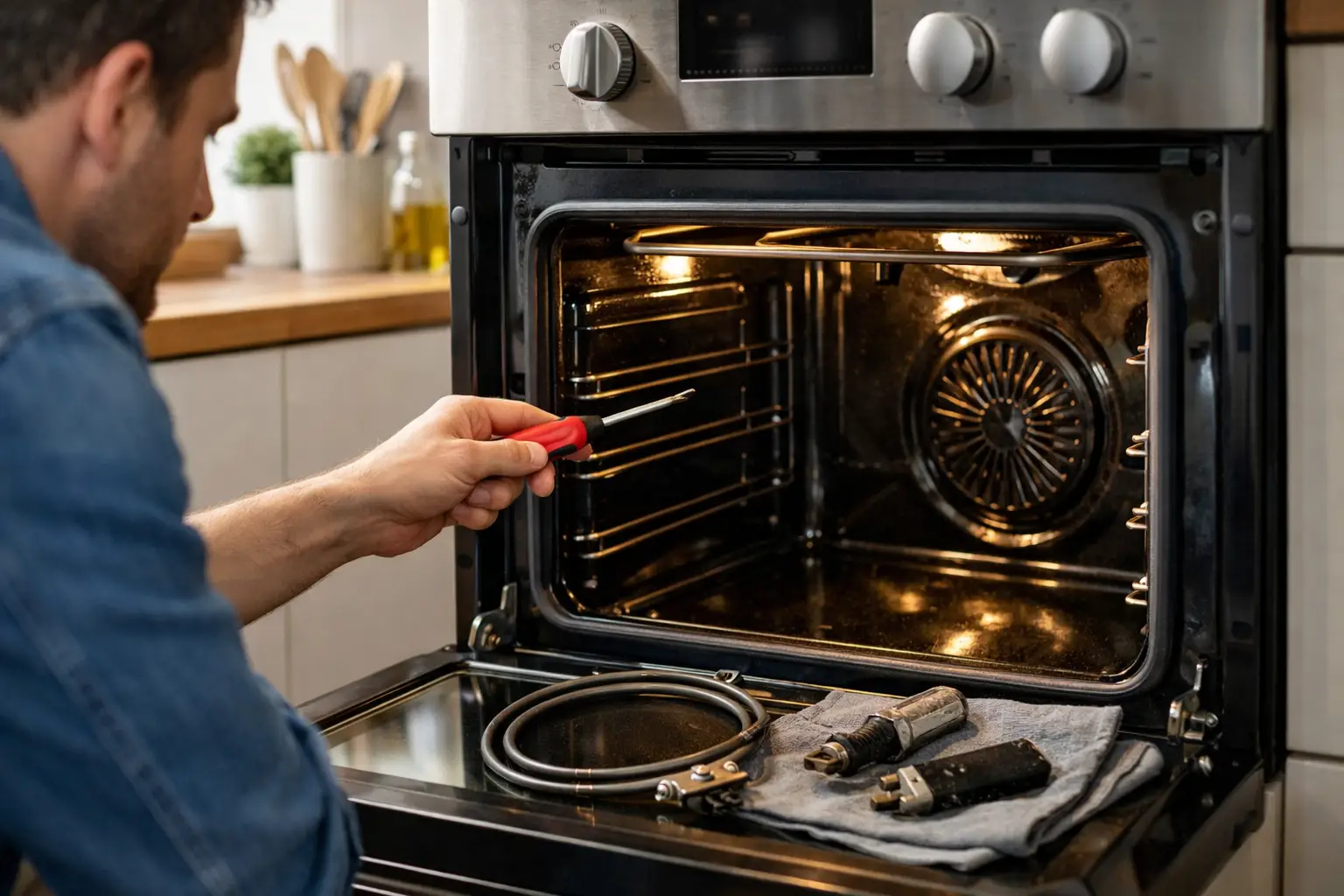
The bake element is the metal tube along the bottom inside an electric oven. It gets red hot during many bake cycles. Over time, it can crack, blister, sag, or burn through.
With the oven cool and off, inspect the lower element with a flashlight. A visible split, rough burned spot, or section that has lifted away from the oven floor is a strong sign it has failed. Do not run the oven if the element is broken. It can spark and damage the oven wiring or control board.
Not every bad element shows damage. Some look normal but have an internal break. Testing it correctly requires checking electrical continuity with the power disconnected. That is usually best left to an appliance technician.
The broil element is located at the top of the oven cavity. It can fail in the same way. If the oven will bake but cannot broil, or if broiling takes far too long, the upper element should be checked.
Gas Oven Not Heating: The Igniter May Be Weak
Most modern gas ovens use a glow igniter. When you start Bake, the igniter should begin glowing orange. Once it gets hot enough, it opens the gas safety valve and lights the burner.
A weak igniter may glow but still fail to open the valve. This confuses many homeowners because the part appears to be working. Common signs include no flame after a minute or two, a gas smell without ignition, or an oven that takes a very long time to heat.
If you smell gas, turn the oven off. Do not keep trying to restart it. Open windows if it is safe to do so, avoid switches and flames, and follow your gas provider’s safety instructions if the smell is strong or continues. A gas oven problem should not be treated as a trial-and-error repair.
Some older gas ovens use a pilot light instead of a glow igniter. A pilot that is out, dirty, or not positioned correctly can prevent heating. The model and age of the appliance make a difference here.
The Oven Sensor Can Cause Wrong Temperatures
Sometimes the oven heats, but it does not reach the temperature you selected. It may stop at 250 when set to 350, burn food even at a low setting, or show a preheat message for too long.
The oven sensor is a small metal probe inside the back wall of the oven. It tells the control board how hot the cavity is. If it gives the wrong reading, the control may shut the heat off too early or keep heating too long.
Do not assume the sensor is the problem based on one undercooked meal. Heavy cookware, a crowded oven, frequent door opening, and an inaccurate oven thermometer can affect results. But if the same temperature problem happens repeatedly, the sensor and control system should be tested.
A technician may also find that the oven needs calibration rather than a new part. Calibration changes the temperature setting slightly. It can help when the oven is consistently a little high or low. It will not fix an oven that stays cold or has a failed element.
Control Board and Relay Problems
The electronic control board sends power to the bake and broil circuits. On many models, it uses relays, which are small electrical switches. A failed relay can leave the display working normally while the heating element receives no power.
Signs of a possible control problem include Bake and Broil both failing, error codes, clicking from the control panel, or heating that starts and stops at random. Burned terminals and loose connections can cause similar symptoms.
Control boards are not always the first part to replace. A good diagnosis checks the power supply, elements or igniter, sensor, and wiring first. Replacing a board without testing can waste money, especially on older appliances where part availability and repair cost should be considered together.
Simple Checks You Can Make Safely
There are a few homeowner checks that do not require disassembly. Keep them basic:
- Confirm the oven clock is set and no delayed-start, Sabbath, or control-lock setting is active.
- Check the breaker once and make sure the display has power.
- Test Bake and Broil separately, then note which mode fails.
- Look for visible damage on electric heating elements after the oven cools.
- For gas ovens, watch for the igniter to glow, but stop immediately if you smell gas.
Do not use the oven as a space heater. Do not bypass a door switch, safety valve, fuse, or thermal cutoff. Do not keep resetting a tripped breaker. These steps can make a repair more expensive and create a safety risk.
When It Is Time to Schedule Oven Repair
Schedule service if the breaker trips again, the oven smells like gas, an element sparks, the oven shows an error code, or neither Bake nor Broil will heat. It is also worth scheduling a visit when preheating has become much slower than normal. A weak igniter or failing element often gets worse before it stops working completely.
For renters, report the issue to the landlord or property manager before arranging repairs unless your lease says otherwise. Property managers can help speed up the visit by sharing the model number, unit number, symptoms, and any error code. A clear description helps avoid delays when a part is needed.
Vertex Appliance Repair provides in-home oven and stove repair for West Hollywood and nearby neighborhoods. The diagnostic fee is $89 and is waived when you approve the repair. Installed parts and labor are covered by a 90-day warranty.
If your oven has stopped heating, avoid repeated test cycles and save the details you noticed. Whether Bake, Broil, or both modes failed will help the technician find the cause faster and get your kitchen back in use with less disruption.